
10.2 Agreement with New Zealand
On this page
- History
- Benefits covered by the Agreement
- Individuals covered by the Agreement
- Claiming payments under the Agreement
- Totalisation
- Requirement to claim a benefit from New Zealand
- Rate calculations for Australian benefits
- Rate calculations for New Zealand benefits
- Payment of supplementary benefits & allowances
- Overpayments, embargoes & debt recovery
- Portability of payments
- Appeals
- Information that can be exchanged
- Duration of the Agreement
- Grandfathering provisions
- New Zealand social security system
History
The Agreement with New Zealand (the Agreement) is a formal treaty under international law and is included in the SS(IntAgree)Act as Schedule 3.
Australia has a long history of social security agreements with New Zealand starting in 1944. Revised agreements were implemented in 1949, 1987, 1989, 1995 and 2002.
The current Agreement with New Zealand started on 1 July 2017. Grandfathering provisions may apply to individuals granted payment under previous agreements – see ‘Grandfathering provisions’ section below for further information.
An interpretative declaration on the Agreement was signed by Australia on 19 March 2025 and approved by New Zealand via diplomatic Third Person Note on 16 September 2025. The interpretative declaration clarifies the interaction between Article 5(1) of the Agreement and Australia’s domestic legislation – see ‘Interpretative declaration on the definition of Australian resident under the Agreement’ section below for further information.
While the Agreement has similar principles to Australia's other bilateral social security agreements, there are a number of key differences in the provisions. These differences arise from Australia and New Zealand sharing similar residence-based social security systems and unrestricted immigration movement.
The most significant difference is that people paid under the Agreement generally cannot be better off by receiving a benefit from both countries. Under the Agreement, the amount of combined benefits (from both countries) cannot exceed the maximum benefit a person would receive from the country in which they are currently residing.
Act reference: SS(IntAgree)Act Schedule 3 New Zealand
Benefits covered by the Agreement
Benefits covered
Article 2 of the Agreement lists the Australian and New Zealand benefits covered by the Agreement.
For Australia, the Agreement covers age pension, DSP for people who are severely disabled, and CP for people whose partner is in receipt of DSP.
For New Zealand, the Agreement covers NZS, Veteran’s Pension, and Supported Living Payment for people who are severely disabled.
DSP and Supported Living Payment for people who are severely disabled
Article 2(2) of the Agreement specifies the criteria a person must satisfy to qualify for DSP or Supported Living Payment within the scope of the Agreement.
To claim DSP or Supported Living Payment under the Agreement, a person must:
- be severely disabled
- have been a resident of Australia or New Zealand on the date they became severely disabled, and
- prior to the date of severe disablement, have resided in the other country for at least 12 months.
Definition of severely disabled
For the purposes of the Agreement, under the definition in Article 1(1)(m), a person is severely disabled if the person:
- has a physical, psychiatric or intellectual impairment (or a combination of these impairments), which, without taking into account any other factor, makes them totally unable to:
- work for at least the next 2 years (see below), and
- benefit within the next 2 years from participation in a program of assistance or a rehabilitation program, or
- is permanently blind (1.1.P.210).
A person is regarded as totally unable to work for the purposes of being severely disabled if their measured capacity to work is 0 to 7 hours per week (that is, less than 8 hours per week) due to their impairment/s. See 1.1.S.110 for more detail.
Definition of date of severe disablement
Under the definition in Article 1(1)(e), the date of severe disablement means the date a person who is applying for DSP or Supported Living Payment is first assessed as meeting the criteria for those benefits under the Agreement. An earlier date can be accepted if evidence supports this and both countries agree.
Interaction between the Agreement and continuing inability to work (CITW)
To qualify for DSP a person must have an impairment rating of at least 20 points and have a CITW (1.1.C.330). Both aspects are of equal importance.
A person has a CITW if they are unable to work (or be re-skilled to work) for 15 or more hours per week, for at least the next 2 years, due to their impairment.
To satisfy the CITW criteria for DSP under Australian domestic legislation, people who do not have a severe impairment (20 points under a single Impairment Table (see 1.1.I.10)), but have 20 points in total across multiple tables must demonstrate that they have actively participated in a POS (see 1.1.P.440). People claiming DSP under the Agreement are generally exempt from meeting this requirement because people residing in New Zealand and non-protected SCV holders in Australia are not eligible to participate in a POS. This exemption also recognises that people claiming DSP under the Agreement are subject to a stricter work capacity test under the definition of severely disabled (that is, totally unable to work) compared to the work capacity test under CITW (that is, work capacity of less than 15 hours per week) and as such are unlikely to benefit from participation in a POS.
People claiming DSP under the Agreement are still subject to other DSP eligibility criteria in domestic legislation, including the requirement to have an impairment of 20 points or more under the Impairment Tables and the residence requirements (Article 5(1) relating to the definition of ‘Australian resident’ and Article 12 relating to 'totalisation can assist people to meet these residence requirements').
Act reference: SSAct section 94(2) A person has a continuing inability to work … section 94(3B) Severe impairment
Policy reference: SS Guide 1.1.S.110 Severely disabled (DSP), 1.1.C.330 Continuing inability to work (CITW) (DSP), 3.6.1.12 Qualification for DSP - 15 hour rule
Individuals covered by the Agreement
Individuals covered
Article 3 of the Agreement specifies the people to whom the Agreement applies, that is:
- people who are or have been an Australian resident, or
- people who are or have been a New Zealand resident.
Article 4 of the Agreement provides that people covered by the Agreement will be treated equally under the social security laws of Australia and New Zealand.
Article 5 of the Agreement defines the terms ‘Australian resident’ and ‘New Zealand resident’ – see below.
Definition of Australian resident under the Agreement
An Australian resident is defined in subsection 7(2) of the SSAct (see 3.1.1.10) and includes people who are residing in Australia and are either an Australian citizen, the holder of a permanent visa or an SCV holder who is a protected SCV holder.
However, Article 5(1) specifies that, for the purposes of the Agreement, this definition of Australian resident also extends to all New Zealand citizens who are lawfully residing in Australia on an SCV. This means that, irrespective of whether they are protected or non-protected, SCV holders who meet Article 5(1) of the Agreement can use the Agreement to satisfy the definition of ‘Australian resident’ in subsection 7(2) of the SSAct. This allows them to satisfy the residence requirements in the SSAct and SS(Admin)Act to claim and qualify for age pension, DSP (if severely disabled) or CP (if partnered to a DSP recipient) under the Agreement, subject to meeting all other requirements.
Example: An SCV holder who is not protected may use Article 5(1) of the Agreement to be considered an Australian resident for the purposes of satisfying the residence requirements in paragraphs 94(1)(e) and/or 94(1)(ea) of the SSAct to qualify for DSP (if severely disabled).
Interpretative declaration on the definition of Australian resident under the Agreement
Australia has signed a formal written statement, known as an interpretative declaration, to clarify how the definition of ‘Australian resident’ in Article 5(1) of the Agreement with New Zealand interacts with the residence requirements in Australia’s domestic legislation. This interpretative declaration has been approved by New Zealand via diplomatic Third Person Note and is considered an authentic interpretation of the text.
Read the interpretative declaration below:
Read the Third Person Note exchange between Australia and New Zealand on the interpretative declaration below:
Definition of New Zealand resident under the Agreement
Article 5(2) specifies that a New Zealand resident is a person who has or had New Zealand as their principal place of residence (except where the person was unlawfully residing/present in New Zealand or only lawfully residing/present in New Zealand because of a visitor’s, temporary work or study permit).
Residence issues
Article 16 of the Agreement specifies that where there is uncertainty over whether a person is a resident of Australia or New Zealand, Services Australia (for Australia) and Work and Income (for New Zealand) will consult on the issue and agree on the person’s country of residence. The decision may be reviewed if the person’s circumstances change.
Act reference: SSAct section 7(2) An Australian resident is a person who …
Policy reference: SS Guide 3.1.1.10 Residence requirements, 9.1.3 New Zealand citizens
Claiming payments under the Agreement
Who can claim?
Normally, to claim a New Zealand benefit under New Zealand’s domestic legislation, a person must be ordinarily resident and present in New Zealand. Similarly, to be able to claim an Australian benefit under Australia’s domestic legislation, a person must be an Australian resident and present in Australia.
The claim lodgement provisions in the Agreement allow people to lodge a claim for a New Zealand and/or Australian benefit where they do not meet the relevant country’s normal claim requirements.
Claims can only be lodged under the Agreement if the benefit being claimed is within the scope of the Agreement. This means that, where the scope for a benefit is limited to people in particular circumstances only, a person must meet those circumstances to make a claim. For example, to claim CP under the Agreement, a person must be the partner of a DSP recipient and, to claim DSP or Supported Living Payment, a person must meet the requirements of Article 2(2), including being severely disabled (see ‘Benefits covered by the Agreement’ section above).
Article 6 of the Agreement allows a person who is not ordinarily resident and present in New Zealand, but is otherwise entitled to receive a New Zealand benefit, to lodge a claim for that benefit if they:
- are either:
- ordinarily resident and present in Australia, or
- present long term in Australia (see note 1 below), and
- have been a New Zealand resident at any time in their life for a continuous period of at least one year since becoming 20 years of age, and
- in the case of NZS or Veteran’s Pension, have reached pension age under this Agreement (see note 2 below).
Article 7 of the Agreement allows a person who is not ordinarily resident and present in New Zealand, but is otherwise entitled to receive a New Zealand benefit, to lodge a claim for that benefit if they:
- are present long term in New Zealand (see note 1 below)
- qualify for an Australian benefit under the Agreement, and
- in the case of NZS or Veteran’s Pension, have reached pension age under this Agreement (see note 2 below).
Article 11 of the Agreement allows a person who is not an Australian resident and present in Australia, but is otherwise entitled to receive an Australian benefit, to lodge a claim for that benefit if they:
- are an Australian resident or New Zealand resident
- are present long term in Australia or New Zealand (see note 1 below), and
- in the case of age pension, have reached pension age under this Agreement (see note 2 below).
Note 1: For the purposes of the Agreement, under the definition in Article 1(1)(l), a person is considered present long term in Australia or New Zealand when they are physically present in a territory of that country, and they have been in that territory for at least 26 weeks or intend to remain in that territory for one year or more.
Note 2: To claim age pension, NZS or Veteran’s Pension under the Agreement, a person must have reached pension age. Article 1(1)(j) of the Agreement defines pension age for the purposes of the Agreement to mean the qualifying age for age pension or NZS, whichever is the higher age at the time of claim. Currently, the qualifying age for age pension (67 years) is the higher age.
Where can claims be lodged?
Under Article 17(1) and the Administrative Arrangements made under Article 21, claims for benefits covered by the Agreement can be lodged:
- in Australia, with any Services Australia office, or
- in New Zealand, with any Work and Income office.
Each country is responsible for processing claims and determining eligibility for its particular benefits. Where a claim for an Australian benefit is lodged in New Zealand, Work and Income will transmit the claim to Services Australia for processing and determination. Similarly, where a claim for a New Zealand benefit is lodged in Australia, Services Australia will transmit the claim to Work and Income for processing and determination.
Date of lodgement
Under Australian domestic legislation, the day on which a claim for an Australian benefit is lodged can affect the date from which payment starts. Under Article 17(2), the date on which a claim form is lodged with either Services Australia or Work and Income is the official date of lodgement for all purposes.
Example: A claim for age pension is lodged with Work and Income in New Zealand and subsequently transmitted to Services Australia. The claim lodgement date when determining the payment start date is the date the claim was lodged with Work and Income, not the date that claim was received by Services Australia for processing.
Article 17(4) also allows for the date of claim for a benefit from one country to be backdated to the date of an earlier claim for a corresponding benefit from the other country if:
- the claimant provides information which indicates they have completed a period of working age residence in the other country, and
- the relevant agency receives the claim for the corresponding benefit within 12 months of the date of lodgement of the first claim, and
- if the claimant is applying for age pension or NZS, the person has reached pension age under the Agreement.
Example: A person lodges a claim for age pension and subsequently lodges a claim for NZS. The date of claim for NZS will be backdated to the date of the earlier claim for age pension, provided the above criteria is met.
Act reference: SSAct section 7(2) An Australian resident is a person who …
SS(Admin)Act subdivision H Residence requirements for claimants, schedule 2 Rules for working out start day
Policy reference: SS Guide 3.1.1.10 Residence requirements, 3.4.1.10 Qualification for Age, 8.1 Claim lodgement, 8.3 Start days
Totalisation
Totalising to qualify for an Australian benefit
Article 12 of the Agreement covers totalisation in order to qualify for an Australian benefit under the Agreement.
Totalisation means that periods of working age residence (see 'Working age residence' section below) in New Zealand can be added to periods as an Australian resident at any time to meet the minimum residence requirements for an Australian benefit under the SSAct.
Explanation: A person can qualify for age pension or DSP if they have been an Australian resident continuously for at least 10 years, or have been an Australian resident for 2 or more periods that in total exceed 10 years, and at least one of those periods is of 5 years duration or more – see 3.4.1.10 and 3.6.1.12.
Note: The definition of Australian resident for the purposes of the Agreement is explained in the ‘Individuals covered by the Agreement’ section above.
A person present long term in New Zealand must have a minimum of one year of working age residence in Australia (6 months of which must be continuous) in order to use Article 12 to totalise to qualify for an Australian benefit. There is no minimum period of working age residence in Australia required for people present long term in Australia.
Note: Under the definition in Article 1(1)(l), a person is considered present long term in Australia or New Zealand when they are physically present in a territory of that country, and they have been in that territory for at least 26 weeks or intend to remain in that territory for one year or more.
If periods of working age residence in Australia and periods of working age residence in New Zealand coincide, the overlapping period is only taken into account once.
Totalising to qualify for a New Zealand benefit
Article 8 of the Agreement covers totalisation in order to qualify for a New Zealand benefit under the Agreement.
New Zealand will count periods of working age residence in Australia as periods when a person was resident and present in New Zealand for the purposes of qualifying for NZS or Veteran’s Pension. The minimum period of working age residence in Australia required to totalise is one year, 6 months of which must be continuous.
New Zealand will count periods as an Australian resident as periods when a person was resident and present in New Zealand for the purposes of qualifying for Supported Living Payment. The minimum period as an Australian resident required to totalise is one year, 6 months of which must be continuous.
Working age residence
Working age residence is defined in Article 5(5) of the Agreement. It refers to periods of residence in Australia or New Zealand from the age of 20 until the qualifying age for age pension or the qualifying age for NZS (whichever is relevant), up to a maximum of 45 years, but does not include any periods of deemed residence under totalisation.
If a person’s working age residence is a number of whole months, or a number of whole months plus one or more days, the period of working age residence is increased to be equal to the number of months plus one month.
Note: For the purpose of DSP rate calculations, working age residence is defined as periods of residence in Australia or New Zealand from the age of 20 until the person’s age at the date of severe disablement.
Policy reference: SS Guide 3.4.1.10 Qualification for Age, 3.6.1.12 Qualification for DSP - 15 hour rule
Requirement to claim a benefit from New Zealand
The Agreement does not contain special provisions that make it compulsory for people claiming an Australian benefit under the Agreement to also claim a benefit from New Zealand. However, under Australian domestic legislation, claimants (including those claiming under an Agreement) can be required to take reasonable action to claim any comparable foreign pension entitlements. This requirement is covered by the CFP legislation explained in 7.3.1.
Policy reference: SS Guide 7.3.1 CFP legislation & requirements
Rate calculations for Australian benefits
General rate calculation
The rate calculation processes to be used for the purpose of Australian benefits under the Agreement are outlined in Article 13 and are to be read in conjunction with provisions in the SS(IntAgree)Act and the SSAct.
Rates are calculated differently depending on whether the person is:
- present long term in Australia (known as the Inside Australia rate), or
- present long term in New Zealand (known as the Outside Australia rate).
Note: Under the definition in Article 1(1)(l), a person is considered present long term in Australia or New Zealand when they are physically present in a territory of that country, and they have been in that territory for at least 26 weeks or intend to remain in that territory for one year or more.
For people who are present long term in Australia (whether they are an agreement pensioner or an autonomous pensioner), the Inside Australia rate calculation depends on whether they also receive a New Zealand pension.
For people who are present long term in New Zealand (whether they are an agreement pensioner or an autonomous pensioner), the Outside Australia rate calculation depends on whether they are receiving age pension, DSP or CP. For those receiving age pension, it also depends on whether they have less or more than 10 years as a New Zealand resident.
See ‘Portability of payments’ section below which outlines the rate calculation method used when a recipient moves between Australia and New Zealand.
Inside Australia rate
Article 13(2) specifies that where an Australian benefit is payable by virtue of the Agreement or otherwise to a person present long term in Australia, their rate of Australian benefit will be calculated as follows:
- Calculate the person’s ordinary income in accordance with the SSAct but disregard any New Zealand benefit to which the person is entitled.
- Apply the relevant rate calculator set out in the SSAct, using the income calculated at Step 1 for the purposes of the income test module.
- Deduct the amount of any New Zealand benefit to which the person is entitled from the maximum rate of Australian benefit calculated at Step 2. This is the rate of benefit payable.
This calculation is intended to ensure a person who is present long term in Australia cannot receive more in total from Australia and New Zealand combined, than a person who has lived their whole life in Australia and is only entitled to an Australian benefit.
Article 13(7) provides that where an Australian benefit is payable by virtue of the Agreement or otherwise to a person present long term in Australia who receives a pension from a third country (that is, not Australia or New Zealand), that person’s rate of Australian benefit will depend on whether they are a permanent resident of Australia.
- If they are a permanent resident of Australia, then any third country pension is treated as ordinary income and included in the calculation of the person’s ordinary income at Step 1 above.
- If not, then any third country pension is disregarded as income at Step 1 above and instead directly deducted at Step 3 above.
Note: The term permanent resident of Australia is defined in Article 5(3) of the Agreement. For the purposes of the Agreement, a permanent resident of Australia is a person who resides in Australia and is an Australia citizen, permanent visa holder or protected SCV holder.
Outside Australia rate (age pension)
Article 13(5)(a) specifies that the rate of age pension payable by virtue of the Agreement or otherwise to a person present long term in New Zealand who has less than 10 years of residence in New Zealand is calculated as follows:
- Calculate the person’s working age residence in New Zealand in months.
- Deduct the result of Step 1 from 540.
- Calculate the rate of age pension the person would receive if they were in Australia and autonomously qualified for the age pension, using the rate calculator set out in the SSAct, but disregarding any New Zealand benefits and any pension the person receives from a third country (that is, not Australia or New Zealand) for the purposes of the income test module.
- Multiply the result of Step 2 by the rate of age pension calculated at Step 3.
- Divide the result of Step 4 by 540.
- Directly deduct any third country pension the person receives from the rate calculated at Step 5. This is the rate of age pension payable.
The rate calculation formula is as follows:
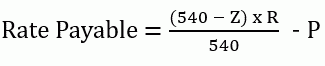
Where:
Z = period in months of working age residence in New Zealand.
R = the rate of age pension the person would receive if they were in Australia and autonomously qualified for the age pension, disregarding any third country pension.
P = any third country pension.
Article 13(5)(b) specifies that the rate of age pension payable by virtue of the Agreement or otherwise to a person present long term in New Zealand who has more than 10 years of residence in New Zealand is calculated as follows:
- Calculate the person’s working age residence in Australia in months (minimum period of 12 months).
- Calculate the rate of age pension the person would receive if they were in Australia and autonomously qualified for the page pension, using the rate calculator set out in the SSAct, but disregarding any New Zealand benefits for the purposes of the income test module.
- Multiply the result of Step 1 by the rate of age pension calculated at Step 2.
- Divide the result of Step 3 by 540. This is the rate of benefit payable.
The rate calculation formula is as follows:
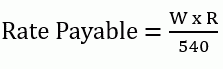
Where:
W = period in months of working age residence in Australia (minimum period of 12 months).
R = the rate of age pension the person would receive if they were in Australia and autonomously qualified for the age pension.
Outside Australia rate (DSP)
Article 13(6) specifies that the rate of DSP payable by virtue of the Agreement or otherwise to a person present long term in New Zealand is calculated as follows:
- Calculate the person’s working age residence in Australia in months between age 20 and the date of severe disablement (minimum period of 12 months).
- Calculate the rate of DSP the person would receive if they were in Australia and autonomously qualified for DSP, using the rate calculator set out in the SSAct, but disregarding any New Zealand benefits for the purposes of the income test module.
- Multiply the result of Step 1 by the rate calculated in Step 2.
- Calculate working age residence in months in New Zealand between 20 and the date of severe disablement.
- Add the result of Step 4 to the result of Step 1.
- Divide the result of Step 3 by the result of Step 5. This is the rate of DSP payable.
The rate calculation formula is as follows:
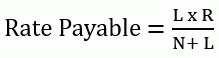
Where:
L = period in months of working age residence in Australia between age 20 and the date of severe disablement (minimum period of 12 months).
R = the rate the person would receive if they were in Australia and autonomously qualified for DSP.
N = period in months in working age residence in New Zealand between age 20 and the date of severe disablement.
Note: The term date of severe disablement is defined in Article 1(e) of the Agreement. It refers to the date a person who is applying for DSP or Supported Living Payment is first assessed as meeting the criteria for the relevant benefit under the Agreement. An earlier date can be accepted if evidence supports this and both countries agree.
Note: Under Article 13(7), if a claimant for DSP has less than 10 years of residence in New Zealand, any pension they receive from a third country (that is, not Australia or New Zealand) is disregarded for the purposes of the income test module of the rate calculation process at Step 2 above and is instead directly deducted from their rate after Step 6.
Outside Australia rate (CP)
Article 13(8) specifies that the rate of CP payable by virtue of the Agreement or otherwise to a person present long term in New Zealand is calculated the same way as DSP above. This means the person receives the same proportion of CP as the DSP recipient they are caring for.
Rate calculations for New Zealand benefits
Detailed information on how New Zealand benefit rates are calculated under the Agreement or otherwise is available from Work and Income.
Inside Australia rate (NZS and Veteran’s Pension)
Article 9 determines the rate of NZS and Veteran’s Pension paid to a person in Australia.
The rate is calculated by multiplying the relevant maximum benefit rate (less a set percentage) by the person’s working age residence in New Zealand in months and dividing the result by 540.
If the person is not an Australian permanent resident, then months of working age residence in a third country can be counted as working age residence in New Zealand. If this applies, any third country benefit the person receives is taken into account when calculating the rate of NZS or Veteran’s Pension.
Any Australian benefits (or third country benefits where the above does not apply) are disregarded when calculating the rate of NZS or Veteran’s Pension.
The rate of NZS and Veteran’s Pension cannot exceed the amount of age pension that would be payable to the person if they were entitled to age pension only.
Inside Australia rate (Supported Living Payment)
Article 10 determines the rate of Supported Living Payment paid to a person in Australia.
The rate is calculated by multiplying the relevant maximum benefit rate (less a set percentage) by the person’s working age residence in New Zealand in months (from age 20 to the date of severe disablement), and dividing the result by 540.
If the person is not an Australian permanent resident, any third country benefit the person receives is taken into account when calculating the rate of Supported Living Payment.
Any Australian benefits (or third country benefits where the above does not apply) are disregarded when calculating the rate of Supported Living Payment.
The rate of Supported Living Payment in Australia cannot exceed the amount of Supported Living Payment payable if the person was residing in New Zealand. Nor can it exceed the amount of DSP that would be payable if the person was entitled to DSP only (if the person is partnered, the rate cannot exceed half of the combined amount of DSP and CP that would be payable to the person and their partner if entitled to these payments only).
Article 6 provides that a single person who is ordinarily resident in Australia is not entitled to receive, or continue to receive, Supported Living Payment if the person reaches pension age under this Agreement and is entitled to receive NZS or Veteran’s Pension.
The only exception is for a person who is ordinarily resident in Australia and is married, in a civil union, or in a de facto relationship. That person is not entitled to receive, or continue to receive, Supported Living Payment if both the person and their spouse or partner has reached pension age under this Agreement.
Inside New Zealand rate
The Agreement does not contain specific provisions relating to the calculation of New Zealand benefits under the Agreement for people in New Zealand. As such, the rate calculation provisions in New Zealand’s domestic legislation apply in this situation.
Note: Under New Zealand’s domestic legislation, where a person is receiving an overseas pension (including a benefit from Australia), the amount of the overseas pension is directly deducted from the rate of New Zealand benefit that would otherwise be payable.
Payment of supplementary benefits & allowances
Article 15 of the Agreement covers the payment of supplementary benefits and allowances.
Australian residents who are in receipt of an Australian benefit under the Agreement are entitled to receive supplementary benefits and allowances (for example, RA, PhA and RAA) payable under Australian social security law. These supplementary benefits and allowances are only payable to a person outside of Australia as provided by Australian social security law.
Where an Australian resident qualifies for an Australian benefit under this Agreement, but the person's rate of payment is zero solely due to the direct deduction of New Zealand benefits (and any applicable third country pension) under the Inside Australia rate calculation, that person shall be deemed to be receiving an Australian benefit. That person will then be eligible to receive relevant concessions, such as a PCC.
New Zealand residents who are in receipt of a New Zealand benefit under the Agreement are entitled to receive supplementary benefits and allowances payable under New Zealand social security law.
Where an Australian resident is receiving a New Zealand benefit under the Agreement, supplementary benefits and allowances are not payable. In addition, no advance payments of an instalment of the primary benefit can be made.
Note: See ‘Definition of Australian resident under the Agreement’ section above for further information.
Overpayments, embargoes & debt recovery
Overpayments due to arrears of New Zealand benefits
Under Article 19(1) of the Agreement, when a person is granted a New Zealand benefit that includes a payment of arrears, the rate of any Australian benefit paid to the person (and/or their partner) during the period covered by the arrears is reassessed retrospectively to determine whether they have received a higher rate of Australian benefit than they were entitled to.
Any overpayment of an Australian benefit resulting from the grant of a New Zealand benefit is a debt due to the Commonwealth.
Note: For the purposes of Article 19, references to a New Zealand benefit or Australian benefit includes any pensions, benefits or allowances from either country, not just those benefits that are in the scope of the Agreement.
Embargoes
Article 19(3) of the Agreement contains embargo provisions. These provisions mean that any overpayment of Australian benefit resulting from the grant of a New Zealand benefit that includes a payment of arrears can be withheld from the arrears payment and paid to Australia. Services Australia International Services is responsible for liaising with New Zealand and making the necessary arrangements.
Debt recovery
A debt resulting from an overpayment of an Australian benefit due to the grant of a New Zealand benefit can also be raised against the person. This would generally only apply where the payment of arrears is not sufficient to fully recover the overpayment through the embargo provisions, or where the arrears have been paid directly to the person and therefore cannot be used to recover the overpayment through the embargo provisions.
A debt can be raised against the person (and/or their partner if applicable) under section 1228A of the SSAct and recovered through the same methods as other debts. See 4.3.6.10 for more detail.
Recovery of other debts through withholdings
Article 19(4) of the Agreement allows Australia and New Zealand to recover certain debts for other overpayments that are not related to a payment of arrears.
The debt can only be recovered at the request of the country that raised the original debt and must comply with the terms and conditions in Part B of the Schedule of the Agreement.
Recovery can be by withholding from a current Australian or New Zealand benefit, instalment or lump sum payment.
If a person in Australia appeals against the recovery of a New Zealand debt, withholdings from the Australian benefit will cease until the appeal is heard.
Act reference: SSAct section 1228A Comparable foreign payment debt recovery
Policy reference: SS Guide 10.1.8.20 Embargoes on Arrears of Comparable Foreign Payment, 4.3.6.10 Income from overseas payments - general rules, 6.7.2 Debt recovery
Portability of payments
Portability refers to a person’s continuing entitlement to a benefit while outside the country that is paying that benefit. Article 14 of the Agreement provides for portability of Australian and New Zealand benefits between Australia and New Zealand, and in some cases to a third country (that is, outside both Australia and New Zealand).
The provisions of Article 14 cover people who are qualified for an Australian benefit under the Agreement and are travelling between Australia and New Zealand or to a third country. They also cover people who are autonomously qualified for a benefit that is within the scope of Agreement (that is, without using the Agreement) and are travelling between Australia and New Zealand.
Where an autonomous or agreement pensioner is travelling between Australia and New Zealand, the calculation of their rate of payment may change, depending on how long they intend to stay or have stayed in the other country (that is, they may move from the Inside Australia rate calculation to the Outside Australia rate calculation or vice versa).
Note: A person who qualifies autonomously for a payment not within the scope of the Agreement is covered by domestic portability rules. These are outlined further in 7.1.
Rate calculation for autonomous pensioners travelling from Australia to New Zealand
A person who qualifies autonomously for a payment within the scope of the Agreement and who travels from Australia to New Zealand temporarily (that is, they intend to be in New Zealand for less than 12 months) will continue to have their payment calculated using the Inside Australia rate for up to 26 weeks.
After 26 weeks, the person is considered present long term in New Zealand, and their payment will be calculated using the Outside Australia rate. They can also claim a New Zealand benefit. However, if they claim a New Zealand benefit within 26 weeks of being in New Zealand (indicating an intention to remain in New Zealand permanently or for more than 12 months), they will be considered present long term in New Zealand, and their payment will be calculated using the Outside Australia rate from the date they applied for the New Zealand benefit.
A person who qualifies autonomously for a payment within the scope of the Agreement and who travels to New Zealand either permanently, or temporarily but with the intention of remaining for more than 12 months, will have their payment calculated using the Outside Australia rate from the date they arrive in New Zealand. They can claim a New Zealand benefit from the same date.
See the ‘Rate calculations for Australian benefits’ section above which outlines the calculation of the Inside Australia and Outside Australia rates of Australian benefits.
Rate calculation for Agreement pensioners travelling from Australia to New Zealand
A person paid an Australian benefit under the Agreement who resides in Australia and travels to New Zealand temporarily (that is, with the intention of being in New Zealand for less than 12 months) will continue to have their rate calculated using the Inside Australia rate for a period of 26 weeks. Once they have been in New Zealand for more than 26 weeks, they will be considered present long term in New Zealand and their rate will be calculated using the Outside Australia rate.
A person paid an Australian benefit under the Agreement who resides in Australia and travels to New Zealand will have their rate calculated using the Outside Australia rate from the date they arrive in New Zealand if they are travelling to New Zealand temporarily, but intend to remain there for more than 12 months, or moving to New Zealand permanently.
See the ‘Rate calculations for Australian benefits’ section above which outlines the calculation of the Inside Australia and Outside Australia rates of Australian benefits.
Rate calculation for Agreement pensioners travelling from New Zealand to Australia
A person paid an Australian benefit under the Agreement who resides in New Zealand and travels to Australia temporarily (that is, with the intention of being in Australia for less than 12 months) will continue to have their payment calculated using the Outside Australia rate for a period of 26 weeks. Once they have been in Australia for more than 26 weeks, their payment will be calculated using the Inside Australia rate.
A person paid an Australian benefit under the Agreement who resides in New Zealand and travels to Australia will have their rate calculated using the Inside Australia rate as soon as they arrive in Australia if they are travelling to Australia temporarily, but intend to remain there for more than 12 months, or moving to Australia permanently and do not qualify autonomously.
See the ‘Rate calculations for Australian benefits’ section above which outlines the calculation of the Inside Australia and Outside Australia rates of Australian benefits.
Note: Recipients of NZS or Veteran’s Pension who travel to Australia must reclaim that benefit within 26 weeks of arriving in Australia. Recipients of Supported Living Payment who travel to Australia must apply for DSP within 4 weeks of leaving New Zealand, qualify for DSP and re-apply for Supported Living Payment within one year of applying for DSP.
Third country portability
Article 14 of the Agreement provides that, for temporary absences to a third country, an Australian benefit is payable in the third country for the portability period in Australian domestic legislation for that benefit or, if the benefit has unlimited portability in Australian domestic legislation, for the period for which the benefit is not proportionalised. This is outlined further in 7.1.
Payment may, by virtue of the Agreement and for temporary absences only, continue beyond the relevant period in domestic legislation if the third country is a country with which Australia has a social security agreement. The calculation of the benefit will generally remain the same for the temporary absence.
A person residing in either Australia or New Zealand who travels to New Zealand or Australia (as the case may be) and then travels to a third country will have their absence in the third country counted from the day they departed Australia or New Zealand.
There is no portability under the Agreement for people departing permanently to a third country. In this event, benefits paid under the Agreement will cease on departure to the third country.
Portability for former Australian residents
SSAct section 1220 provides that former Australian residents who return to Australia to live and are granted age pension or DSP after their return are not entitled to portability of their payment for any absences that occur within 2 years of resuming residence in Australia.
However, former residents who return to Australia and claim age pension or DSP under the Agreement are eligible for portability within the 2-year period if they travel to New Zealand. A person who claims age pension or DSP autonomously can also transfer to be paid under the Agreement to be eligible for portability if they travel to New Zealand.
Act reference: SSAct Part 4.2 Overseas portability
Policy reference: SS Guide 7.1 Portability of payments & concession cards outside Australia
Appeals
People paid under the Agreement have the same appeal rights as those people paid autonomously under domestic legislation.
Article 17 of the Agreement covers lodgement of appeals. Appeals and related documentation can be lodged with Services Australia in Australia or with Work and Income in New Zealand.
The appeal will be subject to the relevant country’s legislation. That is, an appeal in relation to an Australian benefit will be subject to the review and appeal processes specified in Australian domestic legislation and an appeal in relation to a New Zealand benefit will be subject to the review and appeal processes specified in New Zealand domestic legislation.
If an appeal and/or related documentation in relation to a benefit from one country is lodged in the other country, it will be transferred to the other country without delay. The date the appeal is lodged with the first country will be taken as the date of lodgement with the other country.
Information that can be exchanged
Article 18 of the Agreement allows Australia and New Zealand to exchange information needed for the administration of the Agreement.
The information exchanged is confidential and can only be used for the purpose of administering the Agreement and the social security laws of either country.
Part A of the Schedule to the Agreement allows Australia and New Zealand to provide information they receive from each other to taxation authorities for the purposes of assessing a person's tax liability, or detecting fraud or tax evasion.
There is no requirement under the Agreement for either Australia or New Zealand to undertake administrative measures that would conflict with their respective laws or administrative practices, or to provide information which is not obtainable under the laws or the normal course of administration of either party.
This means that all information provided or received by Australia is subject to the same privacy principles as information obtained under Australian domestic legislation. Similarly, information provided or received by New Zealand is subject to privacy legislation relevant to New Zealand.
Policy reference: SS Guide 1.3.3 Privacy & confidentiality
Duration of the Agreement
Duration
Commencing from 1 July 2017, the current Agreement will remain in force indefinitely, unless it is terminated by either side.
Termination
Under Article 27, if the Agreement is terminated, the Agreement will remain in force for 12 months following the date on which either Australia or New Zealand advises the other, through diplomatic channels, that they intend to terminate the Agreement.
Following any termination, those people who were being paid, or had lodged a claim and were entitled at that time, under the Agreement prior to its termination will continue to receive that benefit as per the provisions in the Agreement.
Grandfathering provisions
Grandfathering provisions under the current Agreement
Article 26 of the current Agreement preserves the entitlements of people who were already receiving benefits under the 1994 and 2001 Agreements.
Individuals paid under the 1994 Agreement
The 1994 Agreement entered into force on 1 January 1995 and ceased operating from 1 July 2002. In most circumstances, benefits granted before this date continue to be paid under the 1994 Agreement.
People paid under the 1994 Agreement could choose to surrender their benefit and re-apply under the 2001 Agreement. If they chose to do this, they could not be transferred back to payment under the 1994 Agreement.
Age pension can continue to be paid under the 1994 Agreement unless the person leaves Australia and travels to New Zealand for more than 26 weeks or moves to New Zealand permanently. In these circumstances, their payment will be reassessed using the current Agreement.
DSP paid under the 1994 Agreement can only continue to be paid during temporary absences from Australia of 4 weeks or less. People who qualify for DSP and are severely disabled may be able to transfer to payment under the current Agreement if they travel to New Zealand.
PPS paid under the 1994 Agreement can only be paid during a temporary absence from Australia of 4 weeks or less.
PPP paid under the 1994 Agreement can only be paid during a temporary absence from Australia of 4 weeks or less.
People paid under the 1994 Agreement who leave Australia for a third country for a longer period than that specified above, may be able to claim that payment in the third country if Australia has an Agreement with that country.
Note: Although provided for under the 1994 Agreement, from 20 March 2020, WP, WidB and BVA ceased. Recipients of these payments were transferred to another payment, such as age pension, where eligible and are subject to the rules of the 2017 Agreement. PA was also provided for under the 1994 Agreement, however PA ceased from 1 January 2022.
Individuals paid under the 2001 Agreement
The 2001 Agreement entered into force on 1 July 2002 and ceased operating from 1 July 2017. In most circumstances, benefits granted before this date continue to be paid under the 2001 Agreement.
People granted DSP using residence in New Zealand at any age were grandfathered and continue to receive their payment under the 2001 Agreement.
People receiving payments outside Australia and New Zealand at implementation of the current Agreement continued to be entitled to 26 weeks portability for that absence. Any future absences are subject to the portability provisions outlined in Article 14 of the current Agreement.
New Zealand social security system
New Zealand's social security system is based on residence. That is, to receive a New Zealand benefit a person must generally have lived in New Zealand for a specific period of time and be resident in New Zealand.
More information on New Zealand’s social security system is available from Work and Income.
New Zealand superannuation
NZS is New Zealand's equivalent to the age pension. Under the Agreement, NZS is paid to people who have reached either the qualifying age for NZS or the qualifying age for the age pension, whichever is the higher age at the time of claim (currently this is the qualifying age for the age pension). Although NZS is not generally means-tested, any overseas pension (including an Australian benefit) is directly deducted from the rate payable, unless NZS is being paid under a social security agreement which provides otherwise. Additional assistance (that is, supplementary benefits) may be available to those who qualify.
New Zealand Veteran’s Pension
Veteran’s Pension is paid to eligible ex-service people who have reached the qualifying age for NZS.
New Zealand Supported Living Payment
Supported Living Payment provides assistance to people who have, or are caring for someone with, a health condition, injury or disability. It is broadly equivalent to DSP and CP.